Kerrie Owens Arts
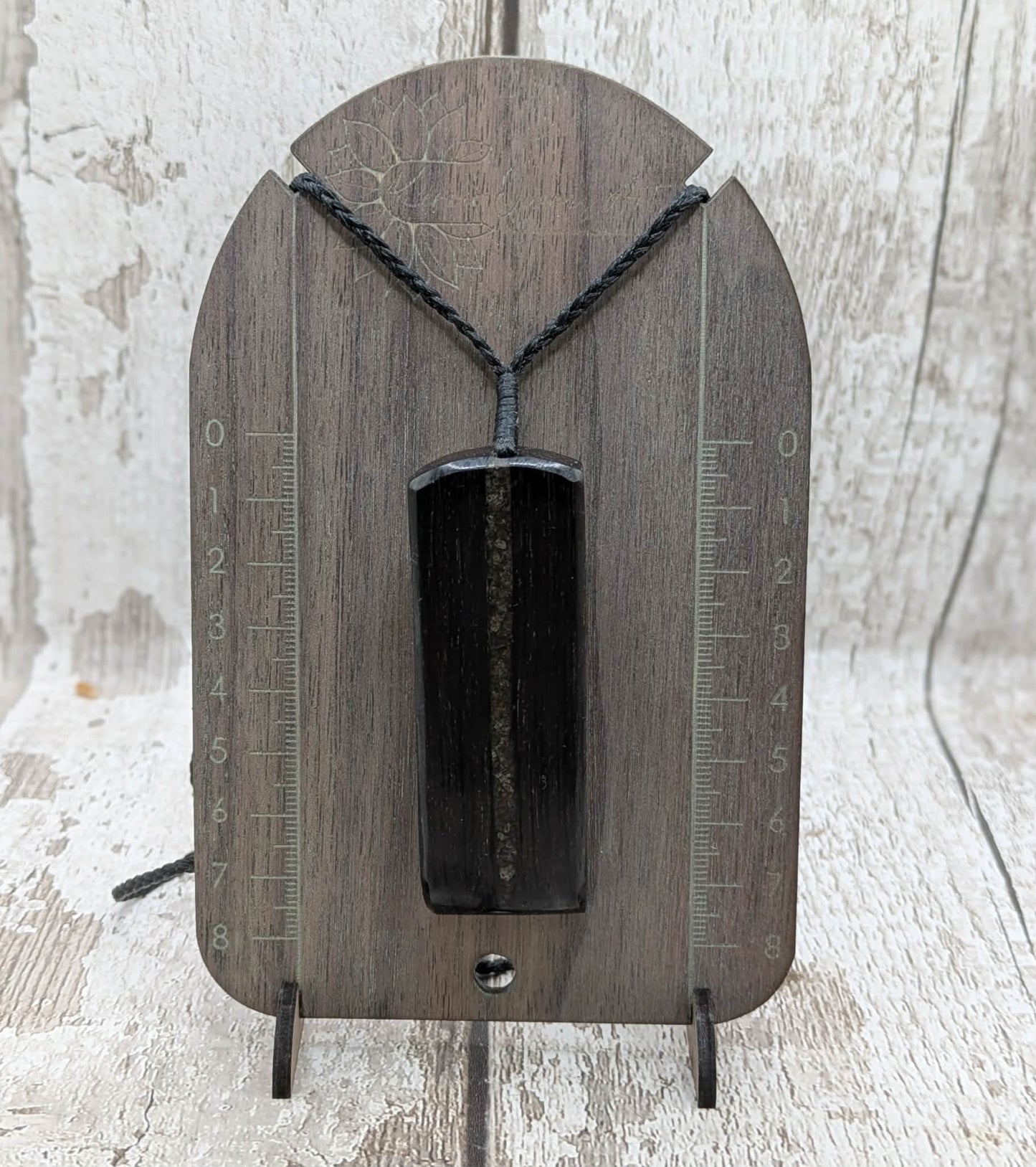
Fenland bog oak with mammoth tooth inlay, Toki adze style pendant.
Fenland bog oak with mammoth tooth inlay, Toki adze style pendant.
Couldn't load pickup availability
Share
Fenland Bog Oak Hei Toki Pendant with Mammoth Tooth Inlay (Doggerland Find)
A contemporary Hei Toki–inspired pendant carved from Fenland bog oak, featuring a central inlay of fossilised mammoth tooth recovered from North Sea sediments associated with the ancient Doggerland landscape. This piece combines two deeply time-anchored materials—prehistoric wetland-preserved wood and Ice Age megafaunal remains—into a single wearable form shaped by modern handcraft. Suspended on an adjustable cord and finished with a natural wax blend, it is designed as a grounded artefact of deep environmental history.
Material & Identity
Fenland bog oak is ancient oak wood preserved within peatland environments across eastern England. Its dark coloration results from long-term chemical interaction between tannin-rich wood and mineralised, oxygen-poor waterlogged soils. Over millennia, this process produces a dense, stable hardwood with a naturally deep tonal range and strong material integrity.
The inlay is fossilised mammoth tooth, recovered from North Sea deposits linked to the submerged prehistoric landmass known as Doggerland. These finds originate from Ice Age sediments exposed and redistributed through marine erosion and dredging activity. Mammoth teeth are composed of layered dentine and enamel structures, often mineral-stabilised over tens of thousands of years.
Formation & Science
Bog oak forms when fallen trees become buried in peat bogs where oxygen deprivation significantly slows decay. Over extended periods, mineral exchange with surrounding groundwater alters the wood’s chemistry, increasing density and producing its characteristic dark, near-black appearance.
Mammoth tooth is biologically composed of alternating bands of enamel, dentine, and cementum, forming a complex wear-resistant structure adapted for grazing Ice Age environments. Over geological time and burial, these tissues undergo partial fossilisation, where organic components are gradually replaced or stabilised by surrounding minerals, preserving structural patterning even when full crystallisation does not occur.
Historical & Environmental Context
Bog oak reflects Britain’s post-glacial wetland forest environments, where large areas of fen and peatland developed following the last Ice Age. Mammoth remains from the North Sea region are associated with Doggerland, a now-submerged land bridge that once connected Britain to mainland Europe during lower sea levels. This landscape contained rivers, forests, and Ice Age fauna before being gradually inundated by rising post-glacial seas.
Together, these materials represent two overlapping ecological chapters: terrestrial wetland forest systems and submerged Ice Age steppe environments.
Symbolism & Cultural Interpretation
In modern interpretation, bog oak is often associated with grounding, ancestral memory, and ecological continuity through preserved organic matter. Mammoth tooth is viewed as a symbol of extinction, endurance, and deep-time survival encoded in biological structure. Combined, this piece is often understood as a dialogue between preservation and disappearance—land that remains and land that was lost beneath the sea.
Craft & Design Detail
The Hei Toki form is hand-shaped to balance weight and symmetry, with the bog oak providing structural depth and the mammoth tooth inlay acting as a visual and material focal point. The contrast between dark preserved wood and pale fossilised tooth emphasises both organic ageing processes and long-term environmental transformation.
The pendant is suspended on an adjustable cord and finished with a mixed natural wax treatment to enhance surface stability, tactile warmth, and grain depth while maintaining a low-sheen organic finish.