Kerrie Owens Arts
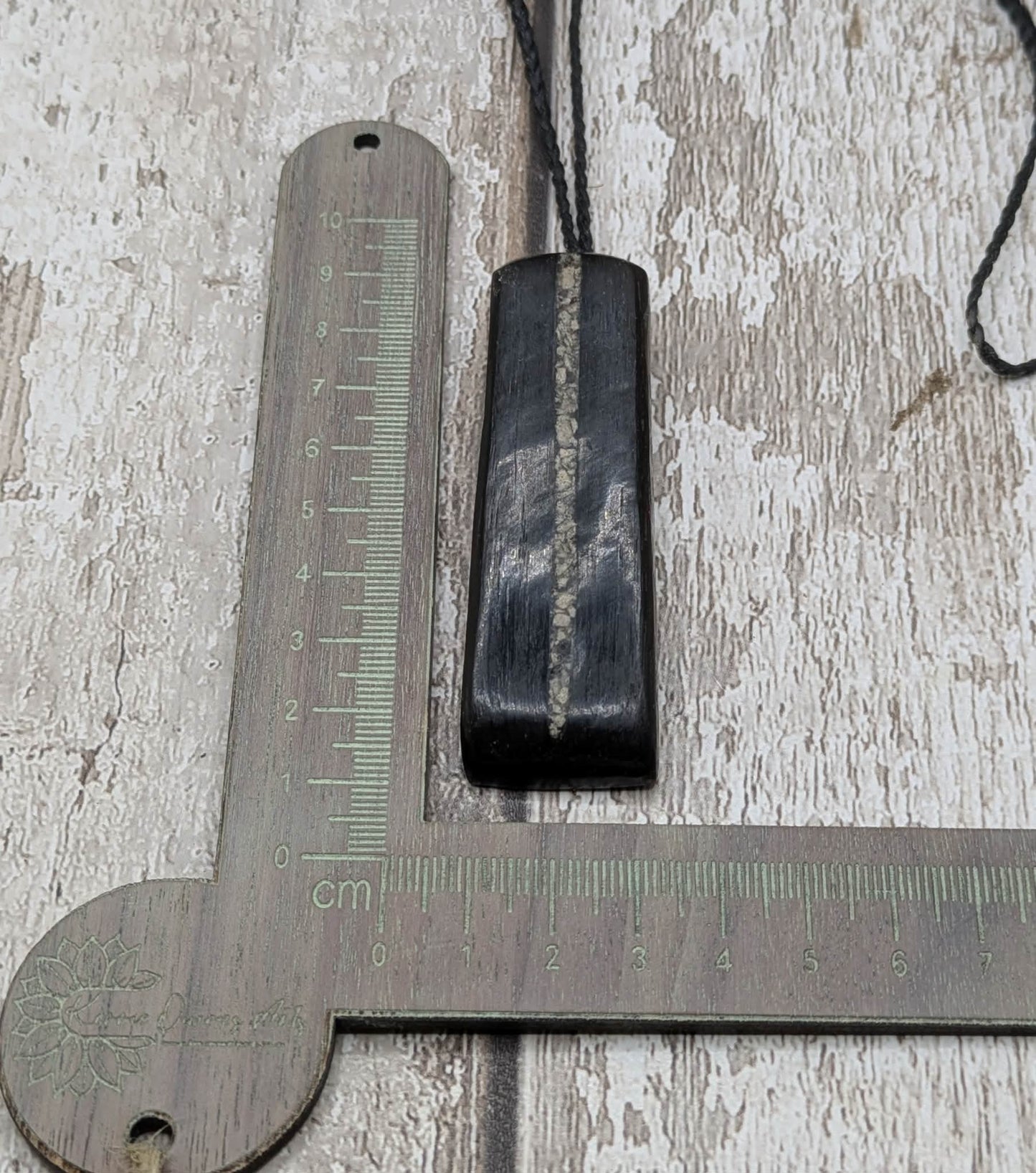
Fenland bog oak pendant with Avebury Sarsen inlay.
Fenland bog oak pendant with Avebury Sarsen inlay.
Couldn't load pickup availability
Share
Dark Fenland bog oak frames a slender, pale line of Avebury sarsen in this contemporary pendant. Its elongated, rectangular outline offers a modern interpretation of the Māori hei toki adze form, brought together with British materials and a personal exploration of ancestry.
A meeting of design and landscape
The inspiration comes partly from the hei toki, a pendant form connected to the Māori adze and the work of shaping wood. Here, that influence is reinterpreted rather than presented as a traditional Māori piece. The result is a meeting of design influences, with preserved oak and sarsen expressing the maker’s connection to British landscapes and ancestral stories.
The symbolism of the hei toki form
In Māori contexts, the toki is an adze, a tool associated with skilled work such as shaping timber and building waka. As a pendant form, the hei toki is often associated with strength, courage, determination and achievement. Its connection to the tool gives those meanings a practical foundation: the patience, knowledge and effort needed to turn a material into something purposeful.
These associations can also speak of facing challenges and carrying the strength to continue. Meanings vary between makers, wearers and cultural contexts; this is not a single meaning shared by every Māori person or tradition.
In this modern interpretation, the adze-inspired shape honours the connection between making and perseverance, while the British wood and stone bring the maker’s own exploration of land and ancestry. It is contemporary jewellery inspired by the hei toki form, not a claim of traditional Māori manufacture.
Fenland bog oak: preserved natural history
Bog oak is oak preserved in waterlogged ground, not a separate species of tree. Oxygen-poor conditions slow decay, allowing the timber to survive while interactions with its burial environment deepen its colour. It remains wood, with the grain of the original tree still visible, rather than stone-replaced petrified timber.
Against that dark grain, the central stone inlay creates a quiet contrast: organic growth beside mineral texture, preserved wood beside enduring stone.
Avebury sarsen and prehistoric Britain
Sarsen is a hard sandstone cemented by silica. It is closely associated with the monumental landscapes of Avebury and Stonehenge, where large sarsen stones were used by prehistoric builders. That is a connection through material and landscape, not a claim that this pendant contains stone taken from either monument.
The stone invites an interest in geology as well as archaeology: sand bound into durable rock, later given a place within a wearable object.
Ancestry, oak and personal symbolism
Oak has a long place in the folklore of Britain and Ireland, including Celtic traditions and English culture, where it is often associated with strength, endurance and protection. Those later traditions are distinct from the much earlier communities who built Avebury and Stonehenge, but both can inspire a present-day connection to landscape and the past.
Some Wiccan, Pagan and other spiritual practitioners work with bog oak as a material for talismans and amulets, associating it with grounding, ancestral connection, protection and transformation. In this pendant, wood and stone can become personal symbols of continuity: the changing, living landscape alongside the enduring earth.
Choose it for its spiritual meaning, its unusual materials or the meeting of natural history and contemporary design. These spiritual associations are personal interpretations rather than scientifically established effects.