Kerrie Owens Arts
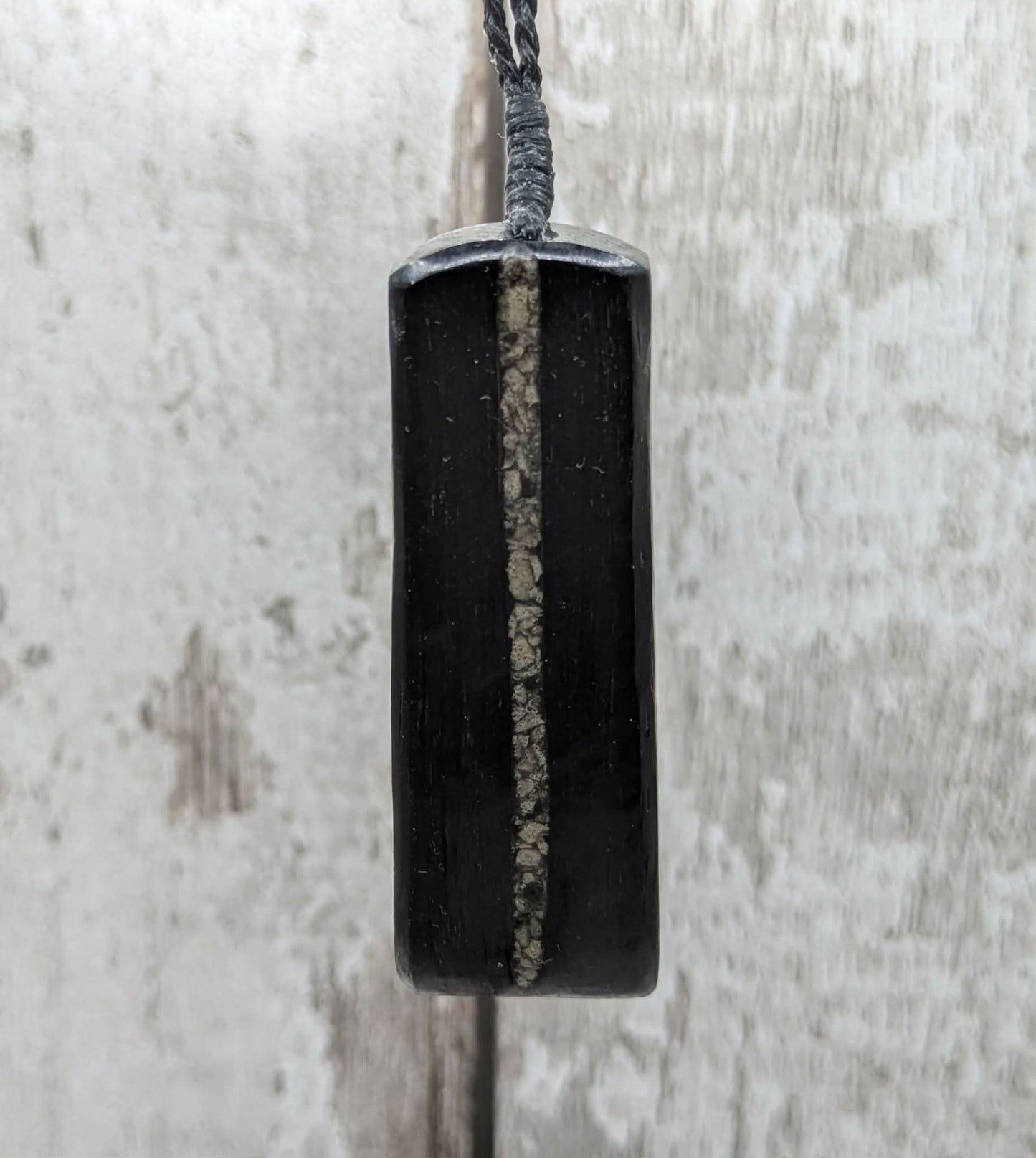
Fenland bog oak and mammoth ivory Toki adze style pendant.
Fenland bog oak and mammoth ivory Toki adze style pendant.
Couldn't load pickup availability
Share
Fenland Bog Oak Hei Toki Pendant with Mammoth Ivory Inlay (Oxfordshire Find)
A contemporary Hei Toki–inspired pendant carved from Fenland bog oak, featuring a central inlay of fossilised mammoth tusk ivory recovered from Oxfordshire. The design unites two deeply time-separated natural materials—ancient wetland-preserved oak and Ice Age megafaunal ivory—into a single sculptural form shaped by modern craftsmanship. Suspended on an adjustable waxed cord, it is intended as both a wearable artefact and a study in deep natural history.
Material & Identity
Fenland bog oak is prehistoric oak wood preserved in peatland environments across Eastern England. Its darkened tone is the result of long-term mineral interaction within oxygen-poor wet soils, producing a naturally stabilised hardwood valued for its density, colour depth, and ancient provenance.
The central inlay is fossilised mammoth ivory, sourced from archaeological and geological finds in Oxfordshire. Unlike modern ivory, this material originates from extinct Ice Age mammoths preserved in periglacial sediments, often mineral-stabilised over thousands of years. It is a fossil material rather than freshly harvested biological ivory.
Formation & Science
Bog oak forms when fallen oak trees become buried in peat bogs, where anaerobic conditions dramatically slow decomposition. Over centuries to millennia, tannin-rich wood interacts with mineralised groundwater, increasing density and producing its characteristic deep brown-black coloration.
Mammoth ivory is composed primarily of dentine, structured in a cross-hatched microcrystalline pattern unique to proboscidean tusks. Over time, burial in sediment leads to partial mineral replacement, stabilising the material and giving it a fossilised, often subtly tinted appearance. Its structure differs significantly from modern elephant ivory and reflects long-term geological preservation rather than recent biological sourcing.
Historical & Natural Context
Bog oak has been recovered and used throughout Britain and Northern Europe as a rare, naturally preserved timber with high material stability. Mammoth remains are frequently discovered in parts of the UK and Europe, including river gravels and glacial deposits, where they have been preserved since the last Ice Age. Together, these materials represent two distinct environmental eras: post-glacial megafauna and post-glacial wetland forest systems.
Symbolism & Cultural Interpretation
In modern interpretation, bog oak is often associated with grounding, ancestral memory, and deep-time continuity through preserved organic matter. Mammoth ivory is frequently viewed as a symbol of extinct strength, Ice Age endurance, and prehistoric presence. Combined within a single form, the piece is often read as a dialogue between survival, extinction, and transformation across geological time.
Craft & Design Detail
The Hei Toki form is hand-shaped to emphasise balance and weight, with the bog oak providing structural grounding and the mammoth ivory inlay acting as a central visual and material focal point. The contrast between dark organic wood and pale fossilised tusk highlights both materials’ natural ageing processes.
The pendant is suspended on an adjustable waxed polyester cord with a barrel knot system for universal sizing and long-term wearability.